Manufacturing strategy with AI
I identify where a company loses time and management attention, which decisions repeat, and where automation is appropriate. The result is a sequence of implementation steps with clear responsibility boundaries.
Rinat Sultanov
I implement AI across sales, data and management inside an operating food manufacturing business. Solutions that prove useful in practice are then adapted for other manufacturers.
Director of Development at Kazan Delicacies. I work at the intersection of commercial operations, data and automation.
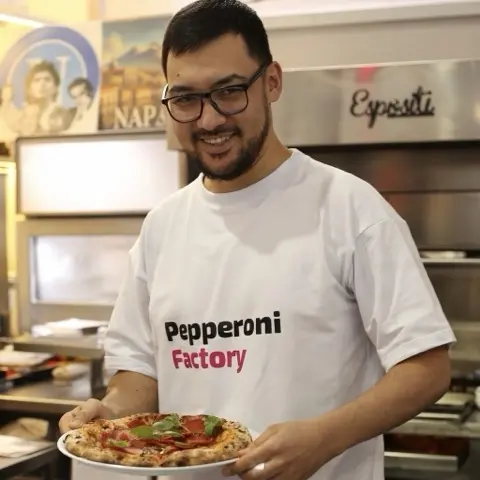
For me, AI implementation is a combination of processes, data and clear responsibility between people and systems.
I test solutions inside an operating manufacturing business first, then adapt the approach for other companies.
systems
The list is updated from this server. Client names and sensitive internal details are not published. System descriptions are currently in Russian.
connecting…
01 / work
I identify where a company loses time and management attention, which decisions repeat, and where automation is appropriate. The result is a sequence of implementation steps with clear responsibility boundaries.
I connect data from 1C, spreadsheets and other sources so management can see the current picture and deviations without waiting for a manually assembled report.
An agent handles repeatable first-touch work: company research, qualification, first-contact preparation and a manager brief. People take over when negotiation, terms and trust matter.
I structure websites so search engines can find them and AI assistants can interpret them consistently. The same content layer should make sense to both people and machines.
02 / method
Quality, safety, client requirements and industry rules define the boundaries of automation before a technology is selected.
We document how work happens today: who decides, where data comes from, where waiting and manual transfer occur, and which actions repeat.
Accounting systems, documents and other sources are connected so information is available without constant manual copying.
AI starts with tasks that can be checked, stopped or rolled back. Irreversible decisions remain under human control.
Each stage should produce a useful result on its own: a clearer process, connected data, time savings or a measurable improvement in quality.
03 / in practice
The catalog and pages are structured so people, search engines and AI assistants can read the same information consistently.
An agent finds and qualifies companies, prepares the first contact and passes context to a manager for the next stage. Case with numbers →
Video and operational data are used to observe shifts and events on the production floor, with deeper automation introduced gradually.
04 / about
My experience combines commercial operations, food manufacturing and digital systems. I therefore treat AI as part of the operating model rather than a separate IT function.
I am Director of Development at Kazan Delicacies, a halal meat-processing business in Kazan. Revenue grew from RUB 58.6 million in 2023 to RUB 869 million in 2025. I do not attribute that growth to AI; the value for this work is having a live business where digital solutions can be tested against real processes.
Inside the company I develop agent-led sales, 1C data workflows, video monitoring, SEO and AI-search visibility. This makes it possible to evaluate solutions by how they perform in day-to-day operations, not only by vendor presentations.
05 / perspective
First define constraints and responsibility, then document the process and connect the data. From there, individual tasks can be transferred to systems and automation can deepen gradually.
Starting with a tool makes it easy to end up with isolated pilots. I prefer the reverse order: business structure and success criteria first, technology second.
06 / formats
For a leader who wants to identify where AI can create practical value and in what sequence to proceed.
In 2–3 weeks I review processes, data, tools already in use and vendor proposals.
The output is a map of opportunities, constraints and implementation sequence.
One measurable process: sales, analytics, inbound requests, the website or production control.
We define the baseline and success criteria before launch, then compare them with actual changes after 90 days.
A working system and clear economics for the next step.
For companies that need a sequence of changes rather than a single pilot.
I work on the owner’s side: sequencing the work, setting result criteria, and coordinating internal and external teams.
No more than 2–3 companies at once.
07 / who I work with
Mid-size and large manufacturers and FMCG companies that need to connect commercial operations, data, management and automation.
Typically these are businesses with established processes and teams where further growth requires more systematic management.
If the company has established processes and a clear business problem, one measurable workflow is enough to start.
08 / technical transparency
Below are saved results from external checks and links to the same tools for any other website.
PageSpeed Insights
agent browsing 3/3 · FCP 0.2 s · LCP 0.3 s · TBT 0 ms · CLS 0 · SI 0.8 s
Open the PageSpeed report ↗Is Your Site Agent-Ready?
100 Level 5 · Agent-Native
Open the scan ↗09 / external references